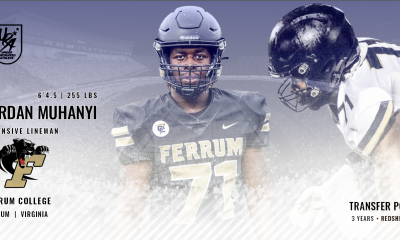
Athlete Spotlight
From Division 2 Ferrum College to The Big Stage: How Jordan Muhanyi Earned His Shot at Division 1 North Carolina A&T


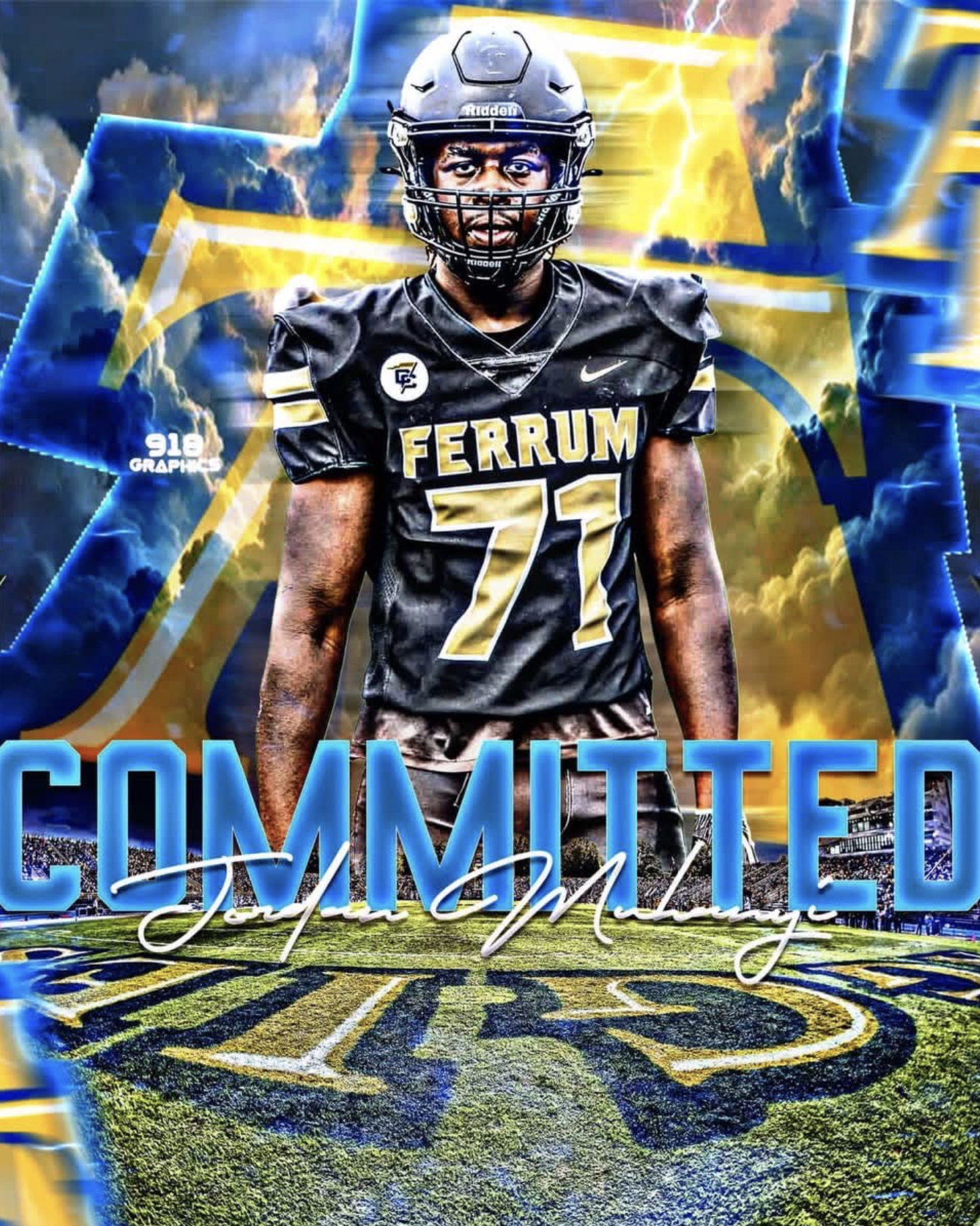
In a college football era defined by uncertainty, overcrowded transfer portals, and shrinking opportunities for both high-school and JUCO players, Jordan Muhanyi is proof that the right preparation, paired with the right network — can change everything. The former Division II offensive lineman has officially committed to North Carolina A&T, sealing a journey built on persistence, exposure, strategy, and the collective effort of a support system that believed in him long before recruiters did.
And in a landscape where more than 4,500 + Division I athletes enter the portal in the first week of the portal cycle this year, and nearly half leave it without a scholarship, Muhanyi’s rise isn’t just a win. It’s a blueprint.
A Different Path: Betting on Playing Time Over Prestige
Coming out of high school, Muhanyi held multiple Division 2 offers and several Division 1 preferred walk-on (PWO) opportunities, the kind many players feel pressured to accept for the “D1 label.” But Jordan chose differently. He chose the path where he could play early, develop, and build real film. In the age of the transfer portal, that decision proved prophetic.
Programs today, especially at the Division I level, are increasingly built through experienced transfer talent rather than raw high-school prospects. Just look at schools like:
- Indiana (Big 10)
- Colorado (Big 12)
- Arizona State (Big 12)
- Louisville (ACC)
- SMU (ACC)
2024 Transfer Portal Activity by FCS Conference
- SWAC (92 athletes)
- MVFC (52 athletes)
- Big Sky, CAA (34 athletes)
- WAC, Southland (26 athletes)
- SoCon (23 athletes)
- ASUN (19 athletes)
- NEC (18 athletes)
- OVC, Big South (14 athletes)
- MEAC (11 athletes)
- Pioneer (8 athletes)
- Patriot (2 athletes)
Key Insights & Takeaways:
- Priority on Proven Players: Coaches across all college football divisions, including FCS, are increasingly prioritizing “ready-made players” from the transfer portal who can contribute immediately over high school players who might require more development time.
- Shrinking High School Classes: This shift has led to smaller traditional high school recruiting classes in many programs, with more roster spots reserved for transfers.
- “Arms Race” in Certain Conferences: The high number of transfers in conferences like the SWAC has been described as an “arms race,” as teams rapidly rebuild rosters to be competitive right away.
- Impact on High School Athletes: The increased use of the portal has made it more difficult for high school athletes, particularly those not considered “blue-chip” prospects, to find opportunities at the Division I level.
All have leaned heavily on transfer classes rather than high school signees. The message is clear: “prove it first” that you can compete right away and dominate at your level, whether at the high school level or lower level divisions of college (Division 2, NAIA, Division 3, JUCO). Jordan understood this before most athletes his age. He bet on himself, was patient, and established a game plan; it paid off.
How Jordan Positioned Himself: Film + Branding + Relentless Effort
Jordan didn’t just play — he went to work building a body of evidence that recruiters could trust.
✔ Strong, consistent game film
The kind of film coaches can evaluate without guessing.
✔ A professional URA Brand Profile Page
This served as his digital résumé — a centralized showcase of:
- Film
- Measurables
- Write-ups
- Background
- Athletic identity
- Social links
- Career narrative
- Transcripts
During a recruitment cycle, coaches are bombarded with thousands of emails and social media DMs, so you only have a small window to pitch your skills. Most often, a coach will review your HUDL Highlights, typically only the first 5 plays or a minute of film. A good athlete’s entire world can crumble due to poor film or poor organization. We suggest that players get a second opinion on their film from coaches or external evaluators who understand what college coaches are looking for by position. Jordan made himself easy to evaluate by demonstrating a strong commitment to self-development and a strong work record.
✔ A Network of Support
Jordan’s journey was not solo:
- Coach Franklin Weaver, who continued advocating for him
- Jordan’s family, who backed every move he made
- URA, which served as the strategic bridge — organizing his story, elevating his visibility, and connecting him to opportunities
✔ Relentless personal effort
Jordan did not sit back and “hope.” He was active, consistent, and engaged:
- Sharing his link regularly on social media
- Following up with leads
- Taking visits
- Staying prepared
In an era when many players enter the portal unprepared and are shocked by what awaits them, Jordan entered the process with a plan, a brand, and a network to help him.
The Transfer Portal Reality — And Why Jordan’s Strategy Worked
College football today is brutally honest:
✔ The portal is overflowing
Thousands enter every cycle thinking opportunity awaits… Most find out the opposite.
✔ D1 coaches want ready-made players
Their jobs depend on winning now, not taking risks.
✔ Offers are becoming “pay-to-play”(an investment must be made through camping, unofficial visits, recruitment services, and brand consulting)
Not literally — but practically. Athletes today must invest in:
- Exposure
- Development
- Resources
- Representation
- Branding
Jordan invested early — and wisely. What he did is exactly what future high school and transfer athletes must do:
Play early, get real film, build a brand, create relationships, and enter the portal ready to get evaluated.
Most athletes enter the portal hoping to be discovered. Jordan entered ready to be chosen.
Why His Commitment Matters
North Carolina A&T did not bet blindly. They saw a player who:
- Has college experience
- Has verified film
- Has a professional brand
- Has advocates
- Has maturity
- Has the physical tools to play now
- Has a story worth believing in
Disclaimer: Recruiting outcomes are never guaranteed. Scholarship offers depend on a variety of factors, including team needs, roster space, coaching decisions, and player performance. Jordan’s success reflects his preparation, timing, and strategy — not a guaranteed result for all athletes. He didn’t just earn an offer; he validated the new model of recruiting success.
A Blueprint for Athletes Everywhere
Jordan Muhanyi’s story is more than a commitment. It’s a signal flare in a confusing era. High school athletes MUST understand that, for many of them, Division 1 may not be in reach due to various factors, despite being All-State, All-Region, All-Conference, or the best athlete in their state. The new formula should be played wherever I can get my school paid, and I can play early.
The portal has replaced high-school recruiting priority. We recommended giving yourself time to transfer by waiting until you understand how to balance college and football, gain sufficient film, and build your network. Most athletes are ready to compete for a starting position as 1 or 2 by their redshirt freshman/sophomore year.
Transfer Portal Athletes
You MUST enter the portal prepared, not hopeful. In today’s climate, film, branding, visibility, and a real network are non-negotiable. If you’re released from a Division I program due to coaching changes or roster turnover, your first step should be reconnecting with your former coaches, following up with programs that recruited you in high school, and building a complete digital résumé through a professional brand profile page.
Parents also need to be part of the process. Exposure is not optional anymore. It’s part of the investment. Their involvement creates the structure, accountability, and organization athletes desperately need once they enter the portal. Because the moment your name appears in that database, you’re starting from zero again, just like high school.
Coaches don’t care that you’re “a portal guy.” They care whether you can help them win NOW. And when they transfer schools, they more often than not bring their recruits and no productive athletes, athletes with poor grades, troubled athletes, red shirts, underdeveloped, twenners with no defined role are out. An athlete’s story matters, relationships matter, and film matters more than ever.
Thousands of athletes lose their careers and remaining eligibility every year because they enter the portal unprepared, without recent film, a network, representation, or a plan. And the further removed you are from your last meaningful snap, the harder it becomes for a college staff to evaluate you or justify giving you a roster spot. College football is a business. New talent enters the workplace every day. You are only as valuable as your most recent play. Entire careers and coaching staffs rise and fall based on recruiting classes. Preparation isn’t optional anymore. It’s survival.
Final Word: A Collective Win
For Jordan, this commitment is the product of:
- His own grit
- His family’s support
- His coach’s belief
- URA’s platform and guidance
- A willingness to work strategically behind the scenes
- This wasn’t luck.
- It wasn’t a coincidence.
- It was a preparation meeting opportunity.
And that is exactly the message today’s athlete needs to hear.
Success requires a plan, a platform, and a voice.
Start by creating your FREE Profile, then upgrade to a subscription to build the complete brand presence coaches expect. Take control of your recruitment, tell your story the right way, and position yourself for the opportunities you’ve earned.
Your future shouldn’t be left to chance, take it into your own hands.