Under Recruited Athlete
Michael Pembleton Jr. One of the Most Underrated Defensive Backs in the 2027 Class?


ANDREWS, SC — Recruiting rankings don’t always move as quickly as recruiting evaluations. Michael Pembleton Jr. may be a perfect example. The Class of 2027 defensive back from Andrews High School in South Carolina has already committed to Elon, but his size, athleticism, versatility, and production keep him an intriguing prospect as his recruitment develops. At about 6-foot-2 and 195 pounds, Pembleton has the frame college programs want in a modern defensive back. He has experience at cornerback and safety and enough athletic ability to contribute at wide receiver. But his story becomes even more interesting when you look beyond the recruiting rankings.
THE PRODUCTION WAS ALREADY THERE
Before arriving at Andrews, Pembleton played at Kempsville High School in Virginia. During his junior season, he recorded 26 tackles, four interceptions, five pass breakups, two forced fumbles, a fumble recovery, and a defensive touchdown. Those aren’t projection numbers. That’s production. Pembleton showed an ability to find the football, create turnovers, and impact games from the secondary traits that become particularly valuable when combined with his size and positional flexibility. Then came another important part of his recruiting journey.
Elon evaluated Pembleton early, and that early belief helped lead to his commitment to the Phoenix on July 1, 2026. For Pembleton, however, the decision was about much more than football facilities or the excitement surrounding a college program. Academics played a major role in his evaluation of Elon, as did the opportunity to get on the field early and begin building his college résumé. Pembleton appeared to have a calculated long-term plan: find the right academic fit, compete for early playing time, graduate ahead of schedule, and potentially use graduate football to continue his career at a larger program. It was a mature approach that looked beyond simply chasing the biggest name in recruiting. But that calculation may now be changing.
Pembleton’s visit to Georgia, along with the recruiting attention and coverage that followed, introduced another variable into his recruitment. From URA’s perspective, that’s a positive development. It suggests that a prospect Elon identified early is beginning to attract attention on a larger stage. For Pembleton, though, increased exposure also complicates the decision. As a student-athlete positioned to graduate early, he doesn’t have unlimited time to watch the recruiting process unfold. He must determine whether the academic and early-playing opportunity that originally attracted him to Elon remains the best path—or whether growing interest from programs such as Georgia changes what his future could look like. The question is no longer simply whether Pembleton was overlooked. It’s what he does now that more people are noticing.

THEN GEORGIA STARTED WATCHING
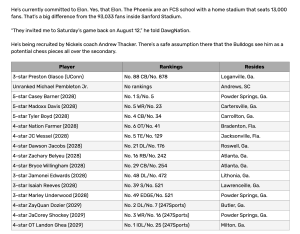
This is where Pembleton’s recruitment becomes particularly interesting. Georgia has shown interest in the South Carolina defensive back, and Pembleton was among the prospects invited to Athens before attending Georgia’s game against Western Kentucky. That does not mean Pembleton has received a Georgia offer. But it does mean something important. He’s being evaluated. And when one of college football’s premier programs begins taking a closer look at a prospect already committed elsewhere, it deserves attention.
Georgia’s nickel coach Andrew Thacker has been connected to Pembleton’s recruitment, providing another indication that his development is being monitored at the Power Four level. For an athlete who has remained relatively under the radar nationally, that’s significant.
THE RANKING DOESN’T TELL THE WHOLE STORY


College defenses increasingly value players who aren’t restricted to one position. Pembleton potentially provides that flexibility. He has the length to compete on the perimeter, the physical profile to develop at safety, and the athleticism to potentially operate in nickel packages depending on how his body develops. His offensive experience at wide receiver also matters. Defensive backs who have played receiver often develop a different understanding of route concepts, body positioning, and how receivers attack leverage. That versatility could ultimately become one of Pembleton’s greatest strengths.
ELON MAY HAVE SEEN IT BEFORE EVERYONE ELSE
Recruiting sometimes becomes a race to discover talent before everyone else does. That’s why Pembleton’s commitment to Elon shouldn’t be treated as a limitation on his potential. It may actually tell another story. Elon evaluated him early and made him a priority. Now larger programs are taking a closer look. That’s recruiting. The program that identifies a prospect before his national profile catches up can sometimes secure a player whose eventual evaluation exceeds where he was ranked when he committed. Whether that happens with Pembleton remains to be seen. But the ingredients are there. Size. Production. Athleticism. Versatility. Power Four interest. And plenty of developmental runway remaining.
URA EVALUATION
Pembleton projects as a long, physical, and versatile defensive back with the athletic profile to play multiple roles at the collegiate level. His combination of ball production, explosiveness, and positional flexibility gives defensive coaches several options when projecting him into a college secondary. The next stage of his development will be important. Continued improvement in technique, coverage discipline, route recognition, and consistency against higher-level competition could determine just how high his ceiling ultimately becomes. But his recruitment already presents an interesting question:
Did Elon identify a Power Four-caliber defensive back before the rest of the recruiting world caught up? Georgia’s continued evaluation doesn’t answer that question yet. But it certainly makes Michael Pembleton Jr. a Class of 2027 prospect worth watching.
Make sure to check out his profile page: https://underrecruitedathlete.com/michael_pembletonjr/