Athlete Spotlight
From Mr. Utility to Division I Potential: John Jachens Is Becoming Difficult to Overlook


BALTIMORE, MD — Some football prospects arrive on the recruiting scene with a reputation already attached to their name. Rankings, camp invitations, social-media attention and a position they have played since youth football make the evaluation relatively straightforward. John Jachens has taken a different route. Before the 6-foot-2, 230-pound defensive end arrived at Mount Saint Joseph High School, Jachens was the kind of athlete Catonsville High School could seemingly put almost anywhere. Defensive tackle. Linebacker. Running back. Special teams. If there was a role that required physicality, effort, and a willingness to collide with somebody, Jachens could find himself doing it.
He wasn’t yet a clearly defined college football prospect. He was something perhaps more appropriate for that stage of his development: Mr. Utility. That versatility made Jachens valuable, but it also presented a challenge familiar to multi-position high school athletes. College coaches aren’t simply evaluating whether someone is a good football player. They’re projecting what that player could become in their program.
Where does he line up? What physical traits translate? What happens after two years in a college strength program? What role gives him the best opportunity to contribute? For Jachens, those questions are beginning to have a clearer answer.
Defensive end.
His move to Mount Saint Joseph gives him an opportunity to take everything that once made him Catonsville’s utility player—the motor, physicality, leverage, strength, and willingness to do whatever was needed—and concentrate those traits into a more defined college position. And that could change the trajectory of his recruitment.
The Motor Came Before the Position
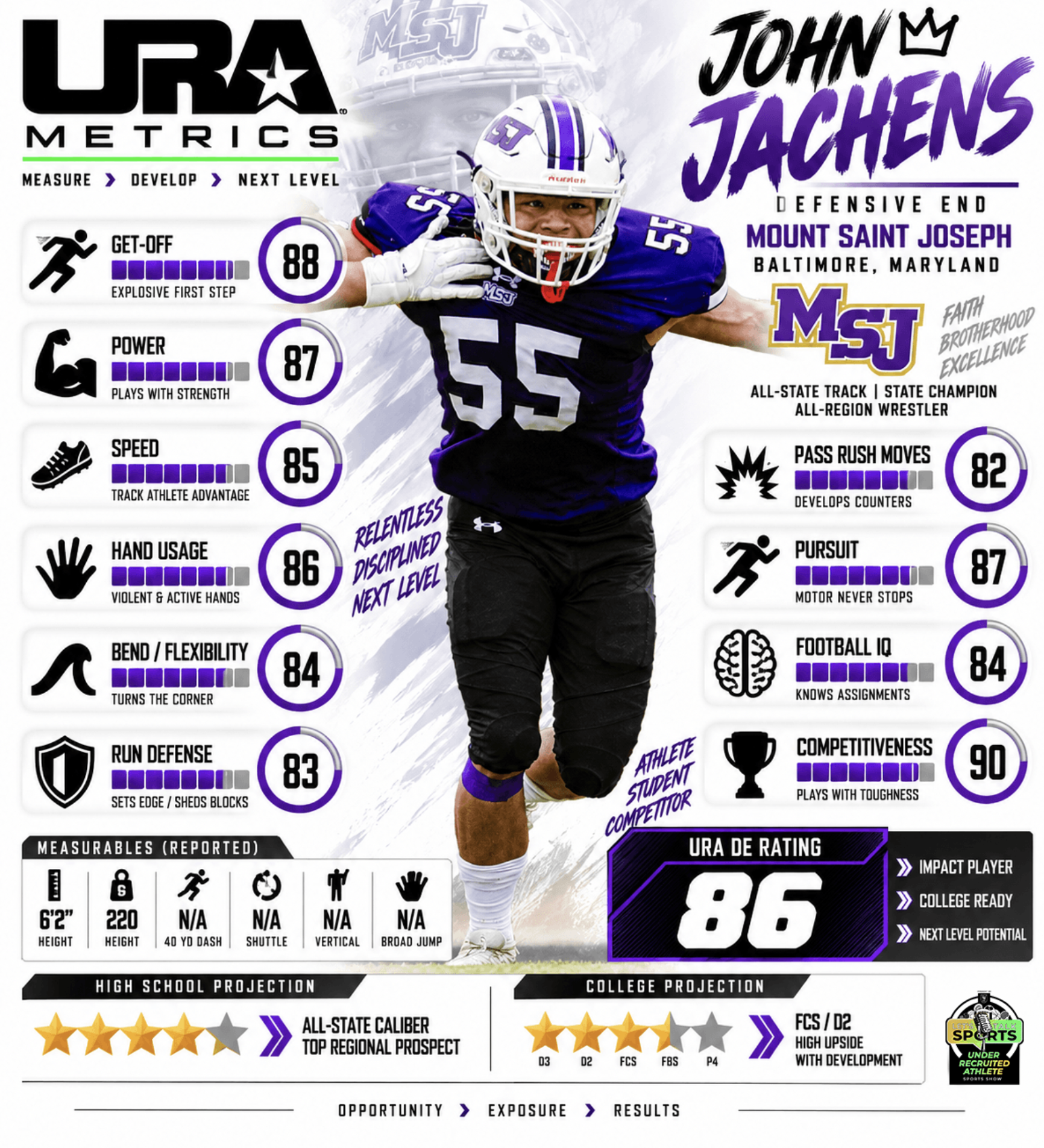
Under Recruited Athlete got an up-close look at Jachens during the 2026 NCEC DMV camp, where he was evaluated as a “do-it-all utility specialist.” His competitiveness, toughness, consistent effort, and motor were among the characteristics that stood out. For a defensive lineman, that last trait matters. Pass rushes aren’t always clean. An offensive tackle recovers. The quarterback steps up. A running back chips. The first move gets stopped. The play extends. Some defenders disappear when Plan A fails. Others keep coming.
Jachens has increasingly built his identity around being the latter. That effort also makes his background at Catonsville more important than it might initially appear. Playing defensive tackle and linebacker while also contributing at running back and on special teams forced him to experience football from multiple perspectives. He wasn’t being groomed exclusively to rush quarterbacks. He was learning how to be useful. Now the challenge is turning usefulness into specialization without losing the versatility that made him valuable in the first place.


Football Is Only Part of the Evaluation
The most interesting part of Jachens’ projection may be what happens when you look beyond football. He is also an accomplished wrestler and track-and-field athlete, and those aren’t merely additional sports listed on a recruiting profile. They provide evidence of physical traits that can matter on a football field.
As a junior at the 2026 Maryland Class 3A outdoor state championships, Jachens finished third in the shot put with a throw of 49 feet, 11 inches. His documented personal bests include 53-6 indoors in the shot put, 52-10.5 outdoors, and 137-9 in the discus. Baltimore County Public Schools also recognized him as the Class 3A boys indoor shot-put state champion during the 2025-26 winter season.
Those numbers don’t make Jachens a Division I defensive end. They do give a college evaluator something objective to work with. Throwing requires lower-body explosion, hip generation, balance, coordination, and the ability to transfer force through the ground and upper body. For a defensive-line coach, the question becomes whether that measurable power can translate into football-specific skills: an explosive first step, violent hands, speed-to-power, and the ability to displace an offensive lineman.
Then there is wrestling. Wrestling demands leverage, balance, hand fighting, body positioning, and an understanding of how an opponent is distributing his weight. It also puts an athlete in an environment where there is nowhere to hide. Once the match begins, solving the problem in front of you becomes personal.
Jachens’ wrestling background provides another piece of evidence when evaluating the physical competitiveness and leverage he brings to football. None of those accomplishments guarantees what happens on Saturdays. Together, however, they make the projection more interesting.
Don’t Evaluate Him Against Only One Prototype
At 6-foot-2 and approximately 230 pounds, Jachens isn’t going to be mistaken for the 6-foot-5, 250-pound prototype that immediately attracts attention from major college programs. That’s reality. But evaluating him solely against that prototype misses the larger question.
Where does John Jachens fit?
Could a defensive scheme use him as a physical edge defender? Could his leverage and wrestling background allow him to play stronger than his height? Could he develop into a hybrid front-seven player capable of moving depending on down and distance? Could his combination of size, power, and effort make him valuable on special teams while his defensive game develops?
Those are the questions that make Jachens particularly intriguing for FCS programs and other Division I staffs willing to evaluate development rather than measurements alone. His path at Catonsville also suggests something college coaches frequently need from younger players: a willingness to contribute before becoming a featured player. Jachens has already played offense, defense, and special teams. He has spent years being asked where he can help rather than telling coaches where he must play. For a college special-teams coordinator, that mentality could have value.
URA believes his combination of motor, physicality, and willingness to run through contact could make him a particularly interesting special-teams prospect while he develops at defensive end. The long-term projection, however, remains on the edge.
Potential Doesn’t Mean Finished
There is an important difference between calling someone a Division I prospect and declaring someone a finished Division I player. Jachens still has development ahead of him. That is part of the evaluation, not something that should be hidden from it. His senior season at Mount Saint Joseph should provide college staffs with more answers.
How consistently can he get off the football?
Can he establish the edge against the run?
Can he use his hands effectively against longer offensive tackles?
Can he translate his throwing power into a legitimate speed-to-power rush?
What happens when his first pass-rush move is stopped?
Can he develop counters?
Can he become disruptive rather than simply active?
And can he add functional size while maintaining the explosiveness that makes his multi-sport background intriguing?
Those are developmental questions worth answering. The mistake would be assuming that because every answer isn’t known today, there isn’t something worth developing tomorrow.
Where Wrestling Matters
Jachens’ wrestling résumé provides perhaps the clearest window into the physical mentality he brings to football. As a sophomore at Catonsville, the county wrestling champion competed at 215 pounds in the 2025 MPSSAA 4A/3A North Region Championships, carrying a 25-8 record into his fifth-place match against Franklin junior Jaidon Williams, who entered at 29-13. Jachens didn’t simply win—he overwhelmed a more experienced opponent, earning a 16-0 technical fall in just 3:56. For a football evaluator, that result says considerably more than simply listing “wrestling” among his other sports.
Wrestling puts Jachens in the kind of one-on-one physical battle that translates naturally to life on the defensive line. Leverage, hand fighting, balance, hip positioning, and toughness aren’t optional when there is nobody behind you to make the tackle and no teammate available to compensate for poor technique. The opponent standing across from you is your problem to solve, and Jachens has demonstrated that he can solve those problems decisively. A 25-win sophomore tech-falling a 29-win junior 16-0 in under four minutes provides college coaches with tangible evidence of the strength, competitiveness, and body control behind his football projection.
That becomes even more relevant when evaluating Jachens as a 6-foot-2, 230-pound defensive end. At the college level, he will routinely encounter offensive tackles approaching or exceeding 300 pounds, and he won’t always own the advantage in height, length, or mass. Wrestling has already taught him another way to win: get underneath an opponent, understand leverage, control the hands, maintain balance, and keep fighting through contact. For a defensive-end prospect who may not fit the traditional prototype on a recruiting spreadsheet, Jachens’ ability to win physical one-on-one battles may be one of the strongest arguments for looking beyond the measurements.


Why FCS Programs Should Be Watching
For an FCS staff searching for developmental value, Jachens presents an interesting collection of traits. He’s approximately 230 pounds. He has documented throwing power. He has wrestling experience. He has played multiple football positions. He has special-teams experience. And his motor has been one of the characteristics consistently identified when URA has evaluated him.
The recruiting question isn’t whether Jachens perfectly resembles another defensive end already playing Division I football. It’s whether a college staff can take his combination of attributes and turn them into something productive. That’s a different evaluation. And potentially a more valuable one. The athlete who has already learned to contribute in multiple roles can offer a coaching staff several possible pathways onto the field while he continues developing at his primary position.
The Academic Piece Matters, Too
Jachens’ academic profile adds another layer. His family reports a 3.4 GPA, while his recruiting profile includes advanced coursework in areas such as aerospace engineering, physics, AP Earth Systems, AP World History, and AP Psychology. That doesn’t automatically make him an Ivy League admissions candidate. Ivy League football recruiting and admissions involve a broader academic evaluation than GPA alone. But it does make academically selective programs an important part of the conversation.
For an Ivy League staff or another strong-academic FCS program, the evaluation becomes broader than height and weight. There is a 230-pound football prospect.
A wrestler.
A championship-level thrower.
A student taking advanced coursework.
A special-teams option.
And a defensive end whose best football may still be ahead of him. That is a profile worth investigating.
From Unknown to Worth Knowing
Perhaps the most compelling part of Jachens’ story is that none of this happened because someone declared him a can’t-miss prospect at 14 years old. He had to build the evidence. At Catonsville, he became Mr. Utility.
He played football.
He wrestled.
He threw.
He competed.
He developed.
His track results became increasingly difficult to overlook. His body continued to mature. His football projection became clearer. And when URA evaluated him, the motor showed up again. Now Mount Saint Joseph provides the next test.
Instead of asking how many different positions John Jachens can play, college staffs can begin asking a more interesting question:
What happens when all of those experiences are finally focused on developing one college position?
Nobody should exaggerate the answer. Jachens’ senior season, continued physical development, and defensive-end film will ultimately determine how high his recruitment can climb. But his résumé already provides enough evidence to warrant another look. A 6-foot-2, 230-pound defensive end with championship-level throwing production, wrestling experience, advanced academics, positional versatility, special-teams value, and a motor that repeatedly appears in his evaluation is exactly the kind of prospect who can challenge initial assumptions about what he might become.
For FCS programs, academically selective schools, and other Division I staffs willing to look beyond rankings and seek developmental value, John Jachens deserves evaluation. Because at Catonsville, Jachens became valuable by being willing to play almost anywhere. At Mount Saint Joseph, he now has an opportunity to prove that the player once known for doing everything may have finally found the position that can take him somewhere much bigger.
Make sure to check out his profile page: https://www.underrecruitedathlete.com/john-jachens